Darkness as Territory. A spatio-temporal understanding of light in the Arctic
Allard van Engelenhoven (2026)
Arctic darkness is increasingly disrupted by expanding infrastructure and artificial light at night (ALAN). Along the Norwegian Arctic coastline, climate change, shipping, resource extraction, and coastal development are extending human activity into spaces and periods historically defined by prolonged winter darkness. While these transformations are often understood through their environmental and economic impacts, less attention has been given to the ecological role of darkness itself. Yet many Arctic species, both human and non-human, rely on seasonal cycles of light and darkness to regulate and structure biological rhythms, biophysical behaviour, and ecological interaction.
This thesis investigates darkness as a critical ecological and temporal infrastructure rather than the mere absence of light. It asks how design can mediate the recognition of darkness as a right of nature, to support ecological regeneration along the Norwegian Arctic coastline.
To address this question, the research develops a multi-scalar framework that combines ecological, spatial, and infrastructural analysis. It examines how terrestrial, aerial, and marine species - including reindeer, little auk, and zooplankton - depend on darkness as a biophysical regulator, and analyses how ALAN generated by shipping, industry, and coastal infrastructure disrupts these relationships. Through a case study of Tromsø, Norway, the thesis develops methods to visualise light and darkness as territorial conditions. Natural darkness is mapped through landscape characteristics such as topography, enclosure, and sky visibility, while artificial illumination is modelled through a designed method visualising coastal light pressure. These layers are combined into an atlas that allows to reinterpret the territory through the lens of light and dark.
The thesis argues that darkness constitutes an ecological condition with intrinsic value that can be identified, mapped, and incorporated into spatial design and planning. By reframing darkness as a subject of environmental protection rather than a residual condition awaiting illumination, it advances a spatial framework for recognising darkness as a right of nature.
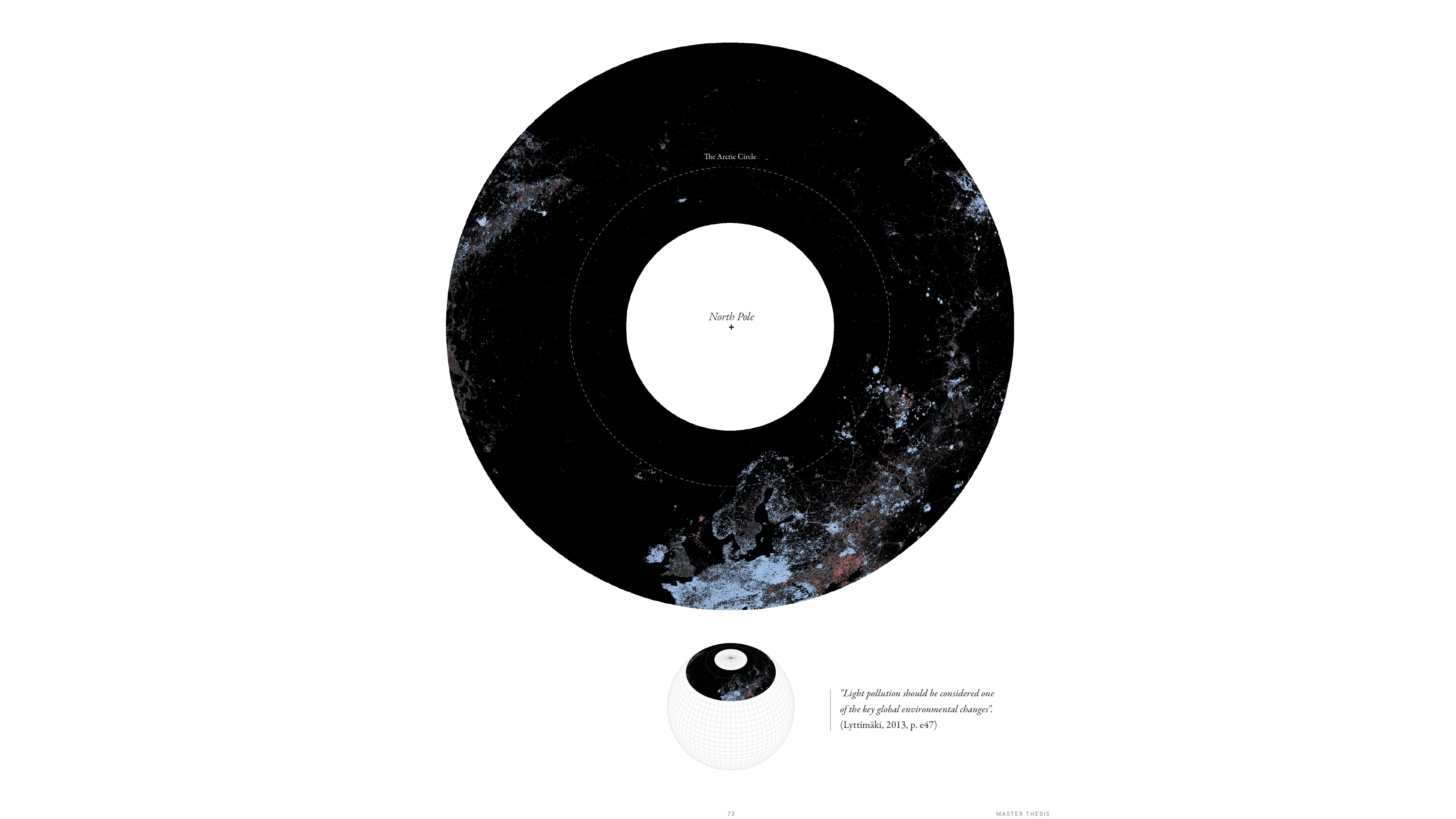
Pan-Arctic changes in ALAN intensity between 1992 and 2013, based on satellite-derived data and pixel-level trend analysis. The map highlights areas of significant increase and decrease in light intensity, as well as stable lit regions. The white disc in the middle has no data due to lack of satellites flying over. data: Akandil et al. (2024)